
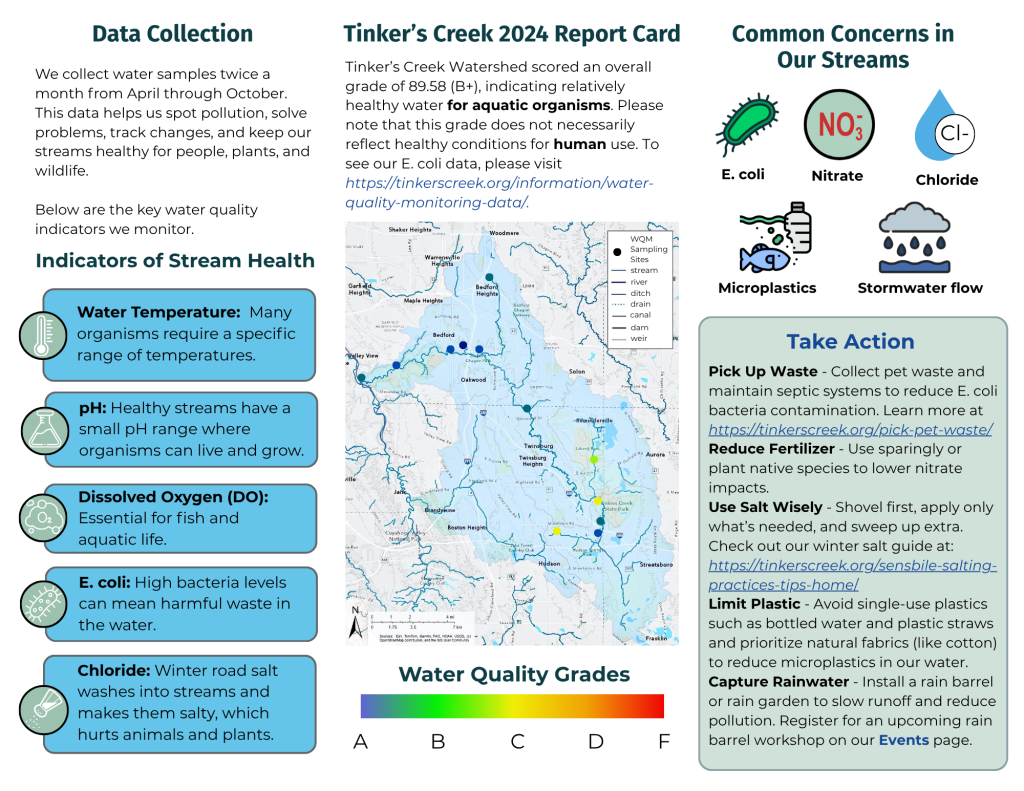
Water Quality Monitoring locations
Tinker's Creek Report Card
Understanding Water Quality
Healthy streams support fish, insects, plants, and people. Some factors are measured regularly, while others are important to know because they affect aquatic life. Below are key water quality factors that help us understand the health of our waterways.
Air & Water Temperature (°C)
Air temperature reflects seasonal changes that affect our streams. Water temperature influences oxygen levels and which fish and plants can survive. Some species need cooler water, while others thrive in warmth.
pH Levels
The pH level tells us how acidic or basic the water is. Most aquatic life can only survive within a narrow pH range. High or low pH can affect nutrient availability and harm fish and other organisms.
Dissolved Oxygen (DO, mg/L)
Fish and other aquatic organisms need oxygen in the water to survive. Dissolved oxygen (DO) levels rise during the day as plants and algae produce oxygen and drop at night as all organisms use it. Low DO can stress or even kill aquatic life.
Nitrite (NO2) & Nitrate (NO3, mg/L)
Nitrite can be toxic to fish and may indicate wastewater pollution.
Nitrate is less toxic but can signal nutrient runoff from fertilizers, contributing to algae growth and low oxygen.
Conductivity (μS/cm)
Conductivity measures how well water carries an electrical current. This increases as the amount of conductive materials (metal ions or salts) increases. Once a baseline conductivity is established for a body of water, we can detect changes from pollution or runoff.
E. coli (cfu)
Escherichia coli is a type of bacteria found in the intestines of animals and humans. High levels in water suggest possible contamination from sewage or animal waste, affecting safety for swimming and recreation.
Total Phosphorous (mg/L) (not included in our testing)
Phosphorus helps plants grow, but too much can lead to harmful algal blooms and fish kills. Monitoring it helps keep ecosystems balanced.
Ammonia (NH3, mg/L) (not included in our testing)
Ammonia comes from natural sources or pollution such as sewage and animal waste. High levels may be a warning sign of potential contamination.
Turbidity (not included in our testing)
Turbidity measures water clarity. Murky water can block sunlight, smother habitats, and make it harder for fish to breathe. It also affects how enjoyable the water is for recreation.